
Picture a parent looking for an allergist for her eight-year-old. She wants to know who treats children, whether the practice offers immunotherapy, and whether it takes her insurance.
Now picture a practice that’s a fit for all three. But its website says “comprehensive allergy care,” its Google Business Profiles don’t clearly explain who it treats, and its directory listings offer little more than an address and phone number.
The practice knows why it belongs on that parent’s shortlist. It just hasn’t made the case in the places AI looks for an answer.
Being a good fit and being recommended are not the same thing. That was the business problem behind my Shore Capital presentation last week on GEO, or generative engine optimization.
The shortlist is being built before the visit to your website
Traditional search gives patients links to investigate. AI search can recommend businesses using information from websites, directories and reviews. (Yext Research)
But the engines don’t all look in the same places. In Yext’s broader local-search study, directories and aggregators accounted for roughly 41% of ChatGPT’s cited sources, while Gemini drew about 42% from businesses’ own websites.
Claude leaned more heavily on review platforms than either of them: about 21% of its citations, compared with roughly 2% for ChatGPT and Gemini. Those figures cover the study overall, not healthcare alone, and describe cited sources rather than everything an engine uses to form an answer.
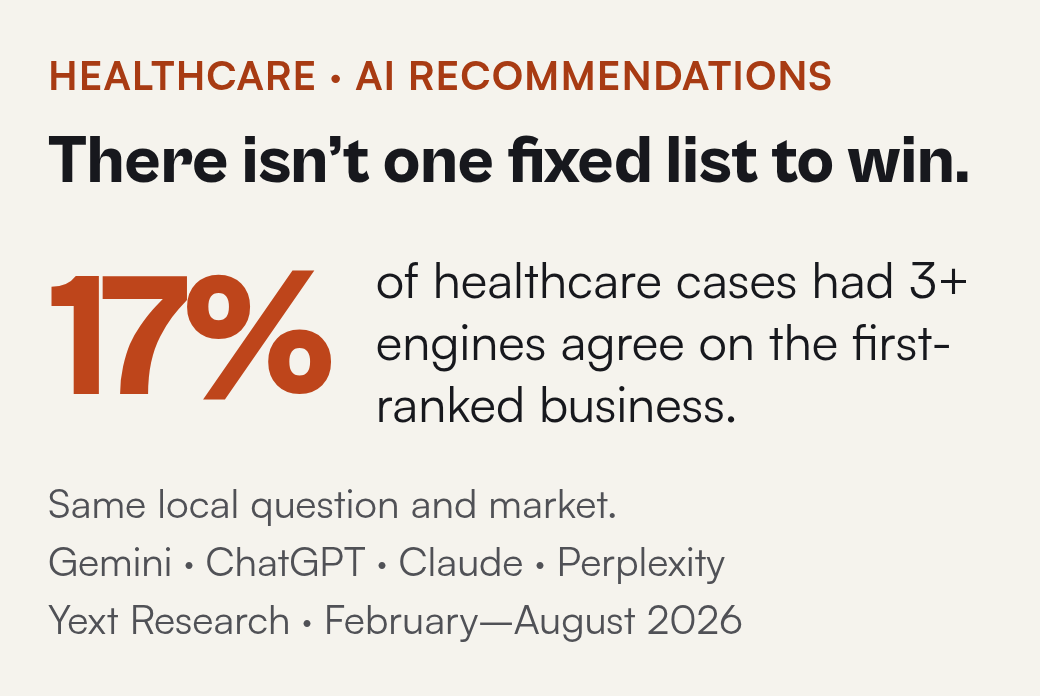
And there isn’t one fixed list to win. In healthcare, at least three of the four AI engines picked the same practice first just 17% of the time.
One favorable answer isn’t a strategy. The job is to build a credible presence wherever those answers draw their information.
The new channel rewards familiar work
Google says the SEO fundamentals still apply to its AI features, with no special AI markup or additional technical requirements. (Google Search Central)
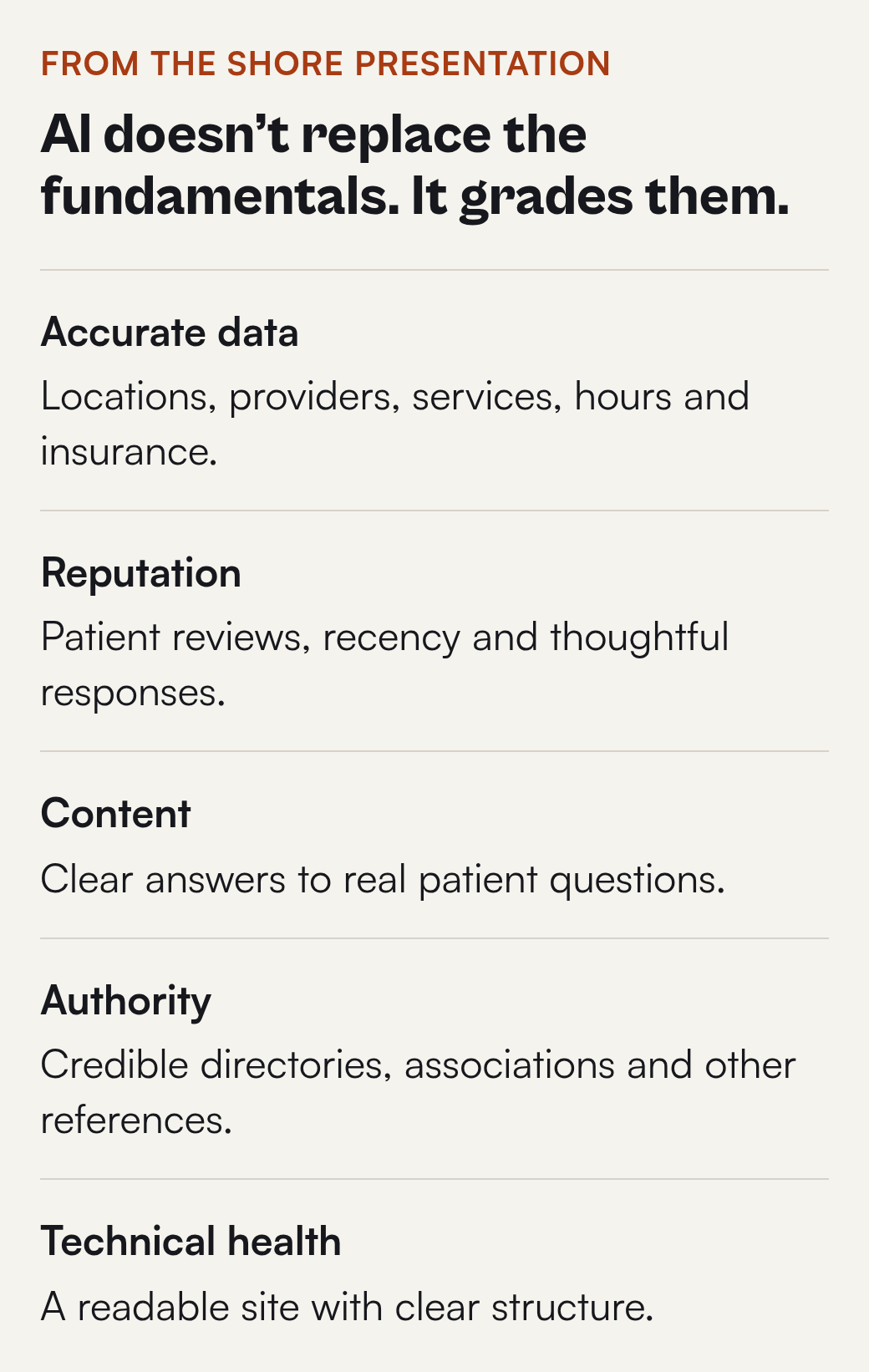
That’s why I see GEO as building on good SEO, not a completely different strategy. But you still need to measure where your practices appear in AI answers, where competitors show up instead, and whether the work is closing that gap.
Here’s where I’d put the effort
For a 120-location healthcare platform, “improve our AI visibility” is too broad to be a useful assignment. I’d turn it into three decisions.
- Pick the markets and patient needs that matter most.
Start with priority growth markets and service lines, not the entire platform at once. Build a set of 15–20 questions patients might actually ask. GEO reporting tools help you track which practices get named, what the answers say, and which sources they cite.
Check out Scout if you’re a multi-location healthcare business trying to understand how each location shows up locally. For broader, national queries, check out Peec.ai. There are several other tools in the market; these are just two we’ve gravitated toward. The point is to give marketing a specific competitive problem to work on.
- Fund the foundation and the reasons to choose you.
Fix incomplete profiles, weak location pages and technical barriers. Alongside that, publish useful explanations of the care, make provider credentials easy to find and build a steady review process. Then develop material that is genuinely yours: clinician expertise, a distinctive treatment process or responsibly reported original findings. Don’t make “we bought a tool” the milestone.
- Track AI visibility. Measure bookings across channels.
First, track the percentage of answers to your monitored AI questions that mention your brands. Keep the questions, markets and engines consistent so you can see the trend over time.
Second, track total booked appointments and blended cost per booked appointment across channels: total marketing spend divided by total booked appointments for the same period.
Don’t judge the impact only by bookings attributed to AI. A patient might research in AI, check the practice on Google, then visit the website to book. BrightLocal’s research shows consumers moving from AI to Google and other channels before deciding, so an AI-only report can miss part of the journey. (BrightLocal)
I wouldn’t cut effective paid search to finance this. I’d give the foundational work a defined budget and owner, then use the results to decide where to expand. This is an investment to manage, not a software purchase to announce.
The Monday Morning Version
Start with three checks from the presentation. Pick a priority market so the first pass stays manageable.
Run the patient questions. Ask 15–20 real questions across the AI engines you’re tracking, without putting your practice name in the question. Record who gets recommended. That’s your starting point.
Check the profiles. Review your Google Business Profiles and key healthcare directory listings. Claim missing profiles, correct outdated details, and fill in services, insurance, walk-in policies and accessibility where those fields are available.
Check the website. Have your web or SEO partner use Search Console to confirm that key location and service pages are indexed. Then read those pages: do they clearly explain what care is offered, who it’s for and where to get it?
The goal is to help AI understand what makes your practice and providers the right fit, so it can help the next patient choose you.