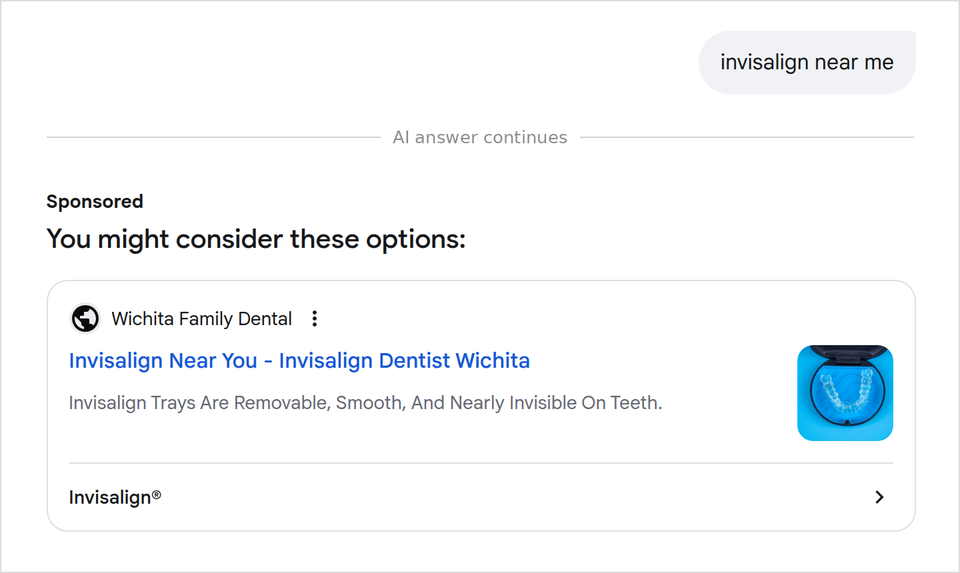
Picture a patient on a Saturday morning, coffee in hand. She asks Google’s AI Mode where she can get Invisalign near her.
She gets a map and a list of well-reviewed orthodontists and dentists. A little further down, a section labeled “Sponsored,” with an ad from a local dental practice.
We ran that exact search this week.
Last issue, I talked about giving AI a reason to recommend your practice. This one is the paid side, and it’s what has me fired up lately.
My take, up front: for most specialties, it’s worth poking at now. Carefully, with a small budget and a booked-appointment target.
Three Big Players Are Already Selling
Google, OpenAI and Microsoft all sell ads inside AI answers today. Perplexity tried it and walked away earlier this year. (The Verge)
Google AI Mode. In June, Google confirmed a small US test of healthcare ads in AI Mode. Ads with pinned headlines or text disclaimers sat out the first phase. (Search Engine Land) And you don’t have to sign up for it. Your existing Search, Shopping and Performance Max campaigns are eligible automatically, and you can’t opt out separately. (Google Ads Help)
ChatGPT. Any US business, any size, can sign up for OpenAI’s self-serve Ads Manager, which is still in beta. Healthcare is where it gets picky. OpenAI’s eligibility table allows minimally invasive cosmetic procedures in the US. Hospitals and urgent care, medical testing and health insurance are limited to a small group of approved advertisers, and OpenAI says it isn’t taking applications in some categories. Telehealth and medical procedures are a no. (OpenAI Help Center) Dental and vision show up in OpenAI’s ad policy as case-by-case, but not in that table, and ads stay out of personal and mental health conversations. (OpenAI)
Microsoft Copilot. If your ad can run on Bing, it can run in Copilot, as long as your search ads have a logo. (Microsoft Advertising)
What Showed Up When We Looked
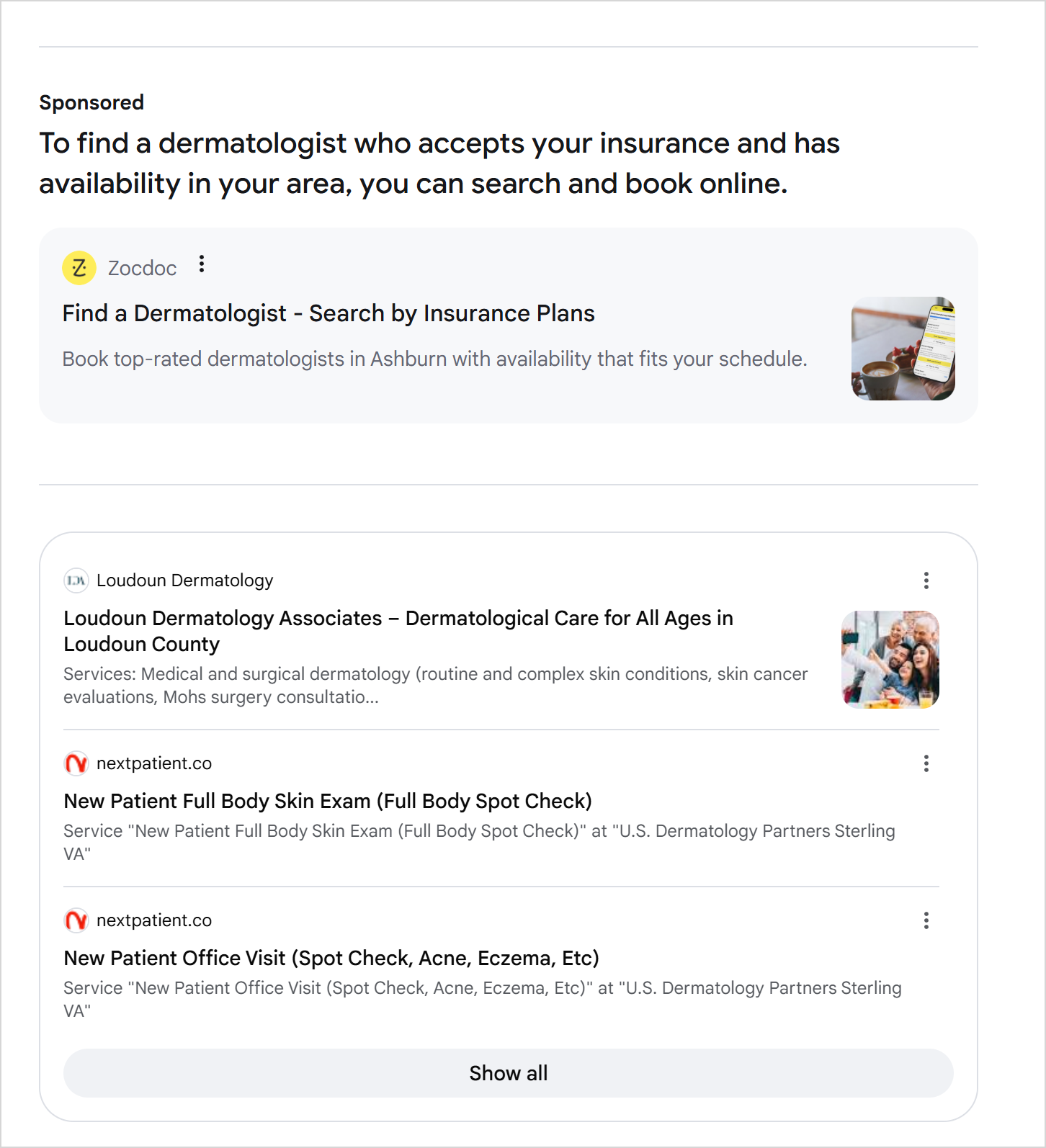
We ran local healthcare searches in AI Mode from Northern Virginia on November 3 and from Wichita on November 7. Dental, dermatology, orthodontic and Invisalign searches turned up sponsored sections at least once. Urgent care, Botox, physical therapy, therapist, implant and LASIK searches didn’t.
The interesting part: in Virginia, Zocdoc sat at the top of both the dental and dermatology ads. Below it were open appointment slots at specific practices, listed under the domains of their scheduling software. One dental group’s slots came through Jarvis, a dental booking tool that connects to Google.
Side note: Zocdoc’s ad sends patients to Zocdoc, where the top spots are paid, too. If you’re listed there but not using its Sponsored Results, it may be time to consider it. You pay per booking, on top of the usual fee.
Where I’d Look First
You may already be in Google AI Mode. If your campaigns use broad match, AI Max or Performance Max, you’re in the pool. Google just added ads in follow-up questions, too. Make sure the right campaigns are eligible, the wrong searches are blocked, and your ads don’t lean on pinning to stay compliant.
ChatGPT is open to some of you. Cosmetic and med spa services can apply today. The US minimum is $25 a day per campaign, about $750 a month. Dental and vision groups can apply and see what OpenAI says. And no, an agency or ad tech partner won’t get you around the rules. OpenAI makes them verify your eligibility, too.
Copilot is a quick fix. Add logos to your Microsoft search ads.
A Few Things to Watch Out For
You can’t see AI Mode results on their own. Google folds them into your normal reports.
Someone else writes the line above your ad. Gemini writes an “AI explainer” on top of it, and you don’t get to edit or approve it.
ChatGPT brings back our old friend, the attribution problem. A patient sees your ad, searches your name on Google, then books. Branded search takes the credit.
The tracking needs a compliance review. OpenAI’s pixel can automatically detect and hash form information. Decide what it can see on a booking page before anyone installs it.
Is It Worth Your Time?
| Specialty | Google AI Mode | ChatGPT |
|---|---|---|
| Dermatology and med spa | Yes | Yes, for minimally invasive cosmetic procedures |
| Dental, orthodontics, vision | Yes | Apply and expect manual review |
| Urgent care | Yes | Limited to select approved advertisers |
| Behavioral health and ABA | Follow existing policies | No |
| Physical therapy and others | Yes | Not eligible yet |
For most of you, Google is the bigger opportunity right now. ChatGPT is a test for cosmetic services and an application for dental and vision.
What We’re Doing With Our Clients
We’re going through each client’s Google campaigns for AI Mode eligibility, checking which ads rely on pinning or disclaimers, and tightening negative keywords.
For cosmetic and med spa clients, we’re proposing one ChatGPT test: one service line, two or three markets, $25 to $50 a day, 60 to 90 days, with a pixel compliance review first. For dental and vision clients, we’re applying and waiting on OpenAI’s answer before we talk budgets.
We judge it on total booked appointments and blended cost per booked appointment, compared with markets that didn’t run the test.
None of this replaces the work from last issue. Google says ads don’t influence its organic AI answers.
The Monday Morning Version
Search your own service lines. Run five AI Mode searches in your top markets and see who’s sitting under the answer.
Ask your paid search team one question. Which of our campaigns could be serving in AI Mode today?
Check OpenAI’s eligibility table. If your service lines are allowed, pick one market and one service line, and write down the booked-appointment goal before you spend a dollar.
You can buy a spot next to the answer. You still have to earn the answer.